The Future of AI-Powered WordPress Website Design and Development
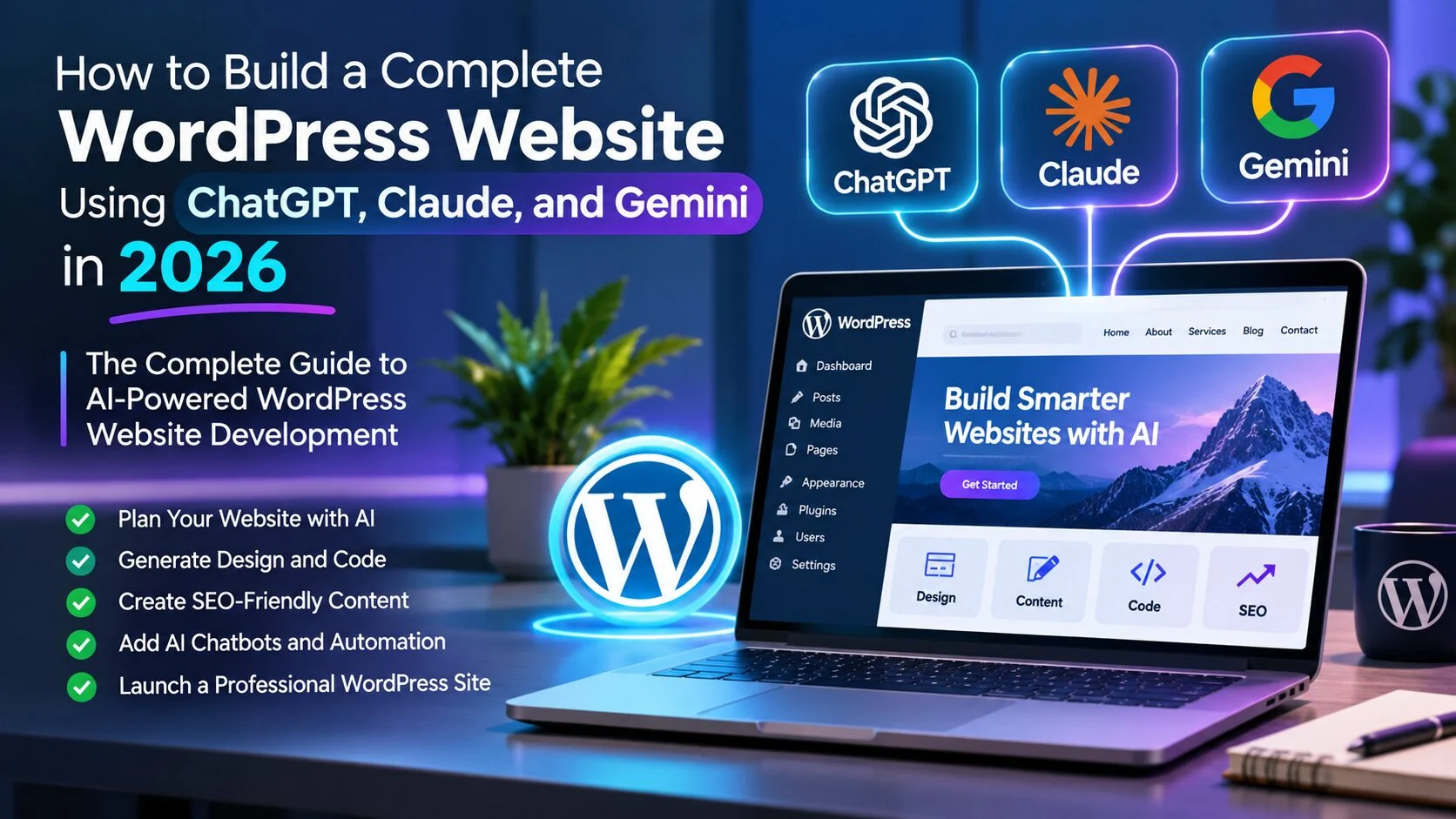
WordPress website development is undergoing a major transformation. With artificial intelligence tools such as ChatGPT, Claude, and Google Gemini, businesses and developers can now create professional websites faster, automate repetitive tasks, and reduce the amount of manual coding required.
Traditionally, building a WordPress website involved selecting a theme, installing plugins, designing pages, writing content, customizing CSS, and testing functionality. Today, AI can assist with almost every stage of that process.
But can AI build an entire WordPress website from scratch? And do businesses still need professional WordPress developers?
Let’s explore how AI-powered WordPress development works in 2026, which tools are worth using, and what this means for businesses.
1. How AI Is Changing WordPress Website Development
AI has evolved from a simple content-writing assistant into a powerful development tool.
Modern AI coding assistants can help developers:
- Generate custom WordPress themes and page layouts.
- Write PHP, HTML, CSS, and JavaScript.
- Build responsive website components.
- Create custom WordPress plugins.
- Generate SEO-friendly website content.
- Troubleshoot coding and compatibility issues.
- Integrate chatbots, forms, and automation.
- Improve website accessibility and performance.
For example, instead of manually writing hundreds of lines of code for a service page, a developer can describe the desired layout and ask an AI coding assistant to generate an initial implementation.
The developer can then refine, test, and integrate the code into WordPress.
The biggest advantage is faster development without sacrificing the ability to customize the website.
2. ChatGPT vs. Claude vs. Gemini: Which Is Best for WordPress?
Each AI platform brings different strengths to the website development process.
ChatGPT for Website Planning, Content, and Coding
ChatGPT is particularly useful during the planning and content development stages.
Developers can use ChatGPT to create website structures, write homepage content, develop service descriptions, generate schema markup, troubleshoot WordPress issues, and produce custom CSS or PHP snippets.
For example, a business owner could request:
“Create a professional five-page WordPress website for a Bay Area landscaping company, including Home, About, Services, Gallery, and Contact pages. Use a modern design, mobile-friendly layout, and local SEO best practices.”
ChatGPT can help generate the sitemap, content, design specifications, and initial code.
However, generated code must still be implemented and tested in the actual WordPress environment.
Claude Code for Custom WordPress Development
Claude Code is particularly valuable for developers working with codebases.
It can help create custom block themes, modify theme files, build WordPress plugins, debug PHP and JavaScript, and refactor existing code.
For agencies managing multiple WordPress websites, this can reduce time spent on repetitive development tasks.
Claude Code can also work alongside local development environments such as WordPress Studio, allowing developers to build and test websites before publishing them.
Google Gemini for AI-Assisted Development
Google Gemini offers additional capabilities for coding assistance, content creation, research, and development workflows.
Developers can use Gemini to generate page components, explain unfamiliar code, draft structured content, and help troubleshoot technical problems.
Gemini can also be useful when working with Google’s broader developer ecosystem, although Google Analytics, Search Console, and Google Ads integrations require their own supported tools and permissions.
The best approach is not necessarily choosing one AI platform. It is using the right AI tools at different stages of development.
3. Step-by-Step: How to Build a WordPress Website With AI
Here is a practical workflow for creating a complete WordPress website using AI-assisted development.
Step 1: Plan the Website Using ChatGPT
Start by defining the business goals, target audience, website pages, branding, and required functionality.
Ask ChatGPT to generate a sitemap, homepage structure, service page outlines, calls to action, and SEO recommendations.
A typical small-business website might include:
- Homepage
- About Us
- Services
- Individual Service Pages
- Portfolio or Gallery
- Blog
- Contact Us
This planning stage establishes a consistent structure before development begins.
Step 2: Generate the Design and Website Code
Next, use Claude Code or another AI coding assistant to create the website’s visual components.
AI can generate responsive navigation menus, hero sections, service cards, testimonials, contact sections, and footer layouts.
For modern WordPress development, developers can create a custom block theme using HTML templates, theme.json, CSS, and JavaScript.
Businesses already using Divi or Elementor can also use AI to create custom CSS, content, and code modules within their existing page-builder workflows.
However, AI-generated HTML is not automatically a complete WordPress theme. It must be properly integrated with WordPress templates, blocks, and functionality.
Step 3: Set Up WordPress and Hosting
Install WordPress on a reliable hosting platform and configure the domain, SSL certificate, and staging environment.
Developers can use WordPress Studio to create a local development website and test changes before deploying them to a live server.
AI-generated themes and plugins can then be installed, configured, and tested.
Important setup tasks include database configuration, backups, security settings, permalink structures, and user permissions.
Step 4: Create SEO-Friendly Website Content
AI can help develop optimized page titles, meta descriptions, headings, service descriptions, FAQs, and blog posts.
For example, a website design company targeting businesses in San Ramon, Pleasanton, Dublin, and the broader Bay Area can use AI to research relevant topics and draft locally relevant content.
However, every page should provide genuinely useful information rather than simply repeating city names and keywords.
Professional review remains essential for factual accuracy, originality, brand voice, and search intent.
Step 5: Add AI Chatbots and Business Automation
One of the most valuable developments is the ability to integrate AI-powered customer interactions into WordPress websites.
An AI chatbot can answer frequently asked questions, collect leads, recommend services, and direct visitors to the appropriate contact or booking process.
With approved integrations, WordPress can also connect to CRM systems, email marketing platforms, appointment scheduling tools, and automation workflows.
For example, when a visitor requests a website design quote, an automated workflow could collect project requirements, notify the sales team, and create a lead record.
These features require proper configuration, data protection, and testing.
Step 6: Test Mobile Responsiveness, Security, and Performance
Before launching, developers should verify that the website works correctly across devices and browsers.
Key testing areas include:
- Mobile and tablet responsiveness
- Page loading speed and Core Web Vitals
- Contact forms and email delivery
- Navigation and internal links
- Accessibility and keyboard navigation
- Security vulnerabilities
- Plugin and theme compatibility
- SEO indexing settings
AI can help identify potential problems, but automated suggestions should not replace real-world testing.
Step 7: Launch the Website
Once the website has passed quality checks, deploy it to production hosting.
Configure redirects where necessary, connect Google Search Console and analytics, submit the XML sitemap, and monitor the website after launch.
The result is a professional WordPress website developed through a combination of AI assistance and human expertise.
4. Can AI Build a WordPress Website Without Coding?
Yes, AI can significantly reduce the amount of coding required, especially for standard business websites.
AI-powered website builders and WordPress tools can generate initial layouts, content, and design elements from written instructions.
However, more complex websites still benefit from experienced developers.
E-commerce functionality, advanced booking systems, custom API integrations, accessibility compliance, security, and complex performance optimization often require technical expertise.
AI can accelerate development, but it does not automatically guarantee a secure, scalable, or high-performing website.
5. Will AI Replace WordPress Developers?
AI is changing the responsibilities of WordPress developers rather than eliminating the need for them.
Previously, much of a developer’s time was spent writing code, modifying themes, creating layouts, and resolving routine technical issues.
With AI, developers can spend more time on website strategy, user experience, custom functionality, performance, security, and business integrations.
Businesses still need professionals who understand how to translate their goals into effective digital experiences.
The future belongs to developers and agencies that combine AI efficiency with strong technical expertise and business strategy.
6. Why Businesses Should Consider AI-Powered WordPress Development
AI-assisted WordPress development offers several potential advantages.
Faster project delivery: AI can generate initial designs, code, and content more quickly, allowing developers to focus on refinement and implementation.
Greater customization: AI coding tools can help create functionality beyond standard theme settings and page-builder options.
Improved efficiency: Repetitive tasks such as content formatting, basic coding, and troubleshooting can be streamlined.
Smarter customer experiences: AI chatbots and automated workflows can improve customer communication and lead handling.
Easier ongoing improvements: AI can assist with website updates, content development, technical analysis, and optimization.
The actual benefits depend on project complexity, tool selection, developer expertise, and quality-control processes.
7. The Future of WordPress Development Beyond 2026
WordPress development is moving toward more integrated AI workflows.
Emerging technologies such as the Model Context Protocol (MCP) are making it possible for compatible AI assistants to interact with external systems through controlled connections.
The WordPress ecosystem is also developing infrastructure to support AI integrations within themes, plugins, and administrative workflows.
Over time, developers may increasingly use natural-language instructions to perform tasks such as creating draft pages, updating website content, generating components, and managing approved workflows.
These capabilities will still require authentication, appropriate permissions, security controls, and human oversight.
The most successful websites will combine AI-assisted development with thoughtful design, strong SEO foundations, reliable hosting, and continuous optimization.
8. Build Your AI-Powered WordPress Website With Silicon Valley Web Solutions
At Silicon Valley Web Solutions, we understand that a successful website requires more than attractive design.
It needs to represent your brand, engage your audience, generate leads, and support your business growth.
Our website development and digital marketing services include WordPress website design, custom development, WooCommerce solutions, search engine optimization, Google Ads management, and ongoing website maintenance.
As AI continues to transform website development, businesses have new opportunities to build smarter, more efficient digital experiences.
Whether you need a new WordPress website, an existing website redesign, or advanced digital marketing solutions, Silicon Valley Web Solutions can help you explore the right approach for your business.
Ready to upgrade your website?
Visit https://siliconvalleywebsolution.com/ to learn more about our website design and digital marketing services.
Frequently Asked Questions
Can ChatGPT create an entire WordPress website?
ChatGPT can help plan a website, generate content, create code, and troubleshoot issues. However, the output must still be integrated into WordPress, configured, tested, and deployed.
Is Claude better than ChatGPT for WordPress development?
Claude Code is a strong option for working directly with codebases and developing custom WordPress themes or plugins. ChatGPT is also useful for coding, website planning, SEO, and content creation. The best choice depends on the project.
Can I use AI with Elementor or Divi?
Yes. AI can assist with page content, custom CSS, HTML modules, JavaScript, design ideas, and troubleshooting within Elementor and Divi workflows.
Is AI-generated WordPress code safe?
Not automatically. AI-generated code should be reviewed for security vulnerabilities, WordPress coding standards, compatibility, and performance before being deployed.
Is WordPress still relevant in the age of AI?
Yes. WordPress remains a flexible content management system, and AI tools can extend its capabilities rather than replace the platform.